Web Hosting With Email (2026): Do You Need Business Email Hosting?
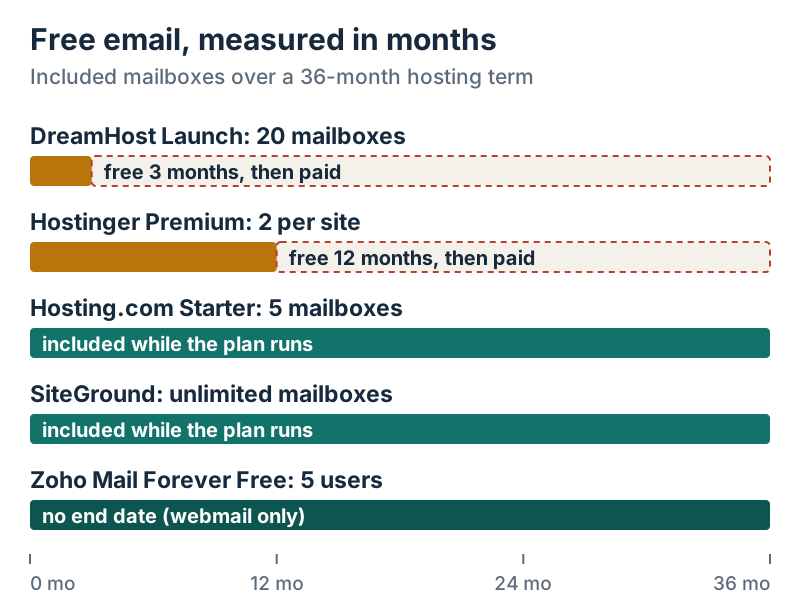
Most web hosting still comes with email, but in 2026 "included" means three different things. Some plans keep their mailboxes for as long as you pay for hosting. Others hand them over free for a trial window, 3 months at DreamHost and 12 at Hostinger, then bill for them. A few treat business email as a separate product altogether. That's the honest answer to "web hosting with email": check how long the email stays free, not just whether a mailbox is listed.
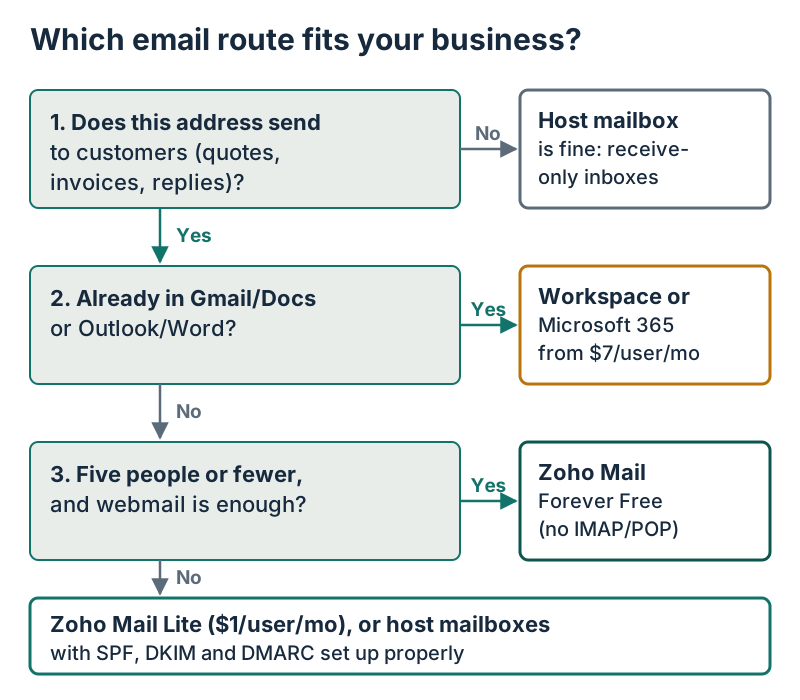
Our verdict: for a receive-only address, such as the inbox behind your contact form, the mailbox in your hosting plan is fine. For the address you send quotes, invoices and replies from, a dedicated provider earns its fee, and for the three providers we price below, that fee runs from $1 to $7 per user per month at list price. This page is for owners choosing a host and wondering whether its mailboxes are enough. If your team already runs on Google Workspace or Microsoft 365 and is happy there, you can skip the comparison: nothing here is a reason to move.
Do hosting plans include email?
Yes, nearly all shared hosting plans include some email, but the catches sit in the duration and the count. We read the plan pages of the hosts small businesses most often shortlist on 9 and 10 October 2026. Three patterns came up. The first is mailboxes for the life of the plan: SiteGround says its plans include unlimited email accounts, and Hosting.com (the former A2 Hosting) lists 5 mailboxes on Starter, 20 on Pro and 40 on Max, at 10 GB each. The second is free for a set time: DreamHost's Web Hosting plans carry a 3-month free trial of its Professional Email, and Hostinger's Premium plan gives 2 mailboxes per website free for 1 year. The third is email as a paid add-on from the first day, which some hosts now sell separately.
The time-limited offers are where small businesses get caught. A 3-month trial ends long before the first hosting renewal, so the email bill arrives on its own schedule, often after the address is printed on invoices and vans. Hostinger doesn't publish what its mailboxes cost after year one, and DreamHost's trial converts to a paid product. Neither is a scandal; both are worth knowing before you build your business identity on them.
Host-included email compared
The table puts the mailbox terms next to the hosting price itself, because the two renew on different clocks. Every hosting price is the advertised first-term price followed by the renewal price, with the term length named; promotional prices apply only to the first term.
| Host and plan | Mailboxes | Email free for | Hosting price (term), then renewal |
|---|---|---|---|
| DreamHost Web Hosting Launch | 20 | 3 months (Professional Email trial) | $2.89/mo first year (1-year term), then $10.99/mo |
| DreamHost Growth | Not shown on the plan card we read | 3 months | $3.99/mo first year, then $12.99/mo |
| Hostinger Premium | 2 per website | 12 months | $2.99/mo (48-month term, $143.52 upfront), then $10.99/mo |
| Hostinger Unlimited | Unlimited per website | 12 months | $3.99/mo (48-month term), then $16.99/mo |
| Hosting.com Starter / Pro / Max | 5 / 20 / 40 (10 GB each) | Life of the plan | Not readable on the vendor page; check at checkout |
| SiteGround (all shared plans) | Unlimited | Life of the plan | StartUp $2.99/mo for the first 12 months, then $17.99/mo |
Two readings of that table matter for a business. First, the cheapest hosting price and the longest-lasting email rarely come from the same row: Hostinger's 48-month term locks in a low hosting price for four years, but its mailboxes stop being free after the first of them. Second, "unlimited" mailboxes on shared hosting still run on the host's shared mail servers, so the count is generous while sending stays limited; Hosting.com, for example, caps outgoing mail at 2,400 messages a day. If what you want is a host whose mailboxes stay included for as long as you pay, SiteGround and Hosting.com are the two on this list built that way. If you'd rather take the low first-year price and run email elsewhere from day one, DreamHost is the cleaner fit, since you lose nothing when its 3-month trial ends.
Google Workspace vs Microsoft 365 vs Zoho: the per-user cost
Separate business email is priced per person, so the bill grows with your headcount rather than your website. Here are the list prices we read on 10 October 2026 from each vendor's US pricing page, all on annual billing.
Google Workspace Business Starter is $7 per user per month with a one-year commitment, with 30 GB of storage pooled per user. New customers were shown an introductory $4.90 for the first 20 users, so check whether the discount still applies when you sign up, and budget for the $7 that follows. Business Standard lists at $14 and Business Plus at $22. Microsoft 365 Business Basic is $7.00 per user per month, paid yearly, with a 100 GB mailbox per user. It runs Outlook, Word and Excel in the browser and on phones only; the desktop apps start at the Standard tier. Zoho Mail Lite is $1 per user per month with 5 GB of storage, or $1.25 with 10 GB, billed annually, and Mail Premium is $4. Zoho also runs a Forever Free plan for up to five users on one domain, with 5 GB each, but it is web access only, with no IMAP, POP or ActiveSync, and Zoho lists it as available only in select data centers.
Our earlier version of this page said Microsoft's entry plan cost about $6 and that its mailbox was 50 GB. Both have changed: the list price is now $7.00 and Microsoft's own service description puts the Business Basic mailbox at 100 GB, with a 50 GB archive on top. If you've budgeted from an older comparison, redo the sums.
The 3-year cost for 1, 3 and 10 people
Because hosting and email renew on different clocks, a three-year view is the fairest way to compare them. The chart below shows only what email adds on top of the hosting bill, at the list prices above, with no introductory discounts counted.
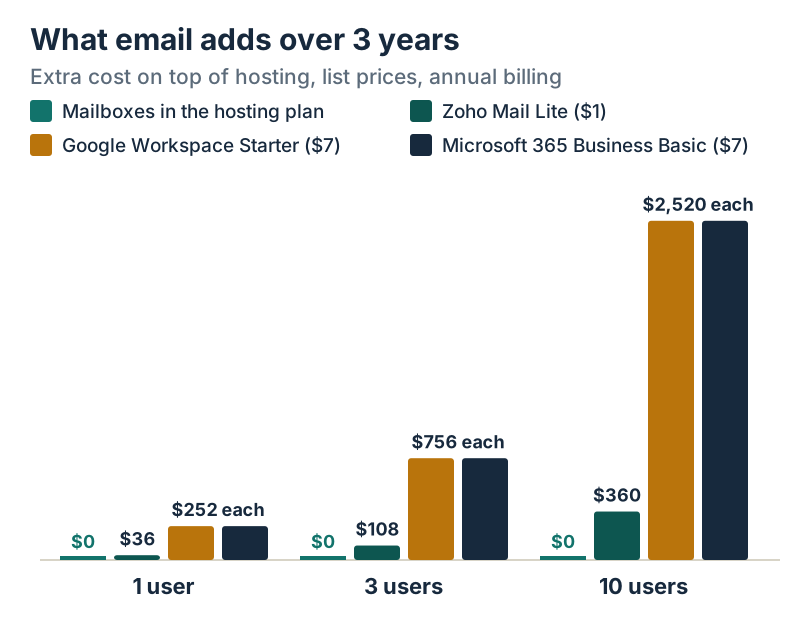
The arithmetic is simple: price per user, times 36 months, times the number of people. One person on Workspace or Microsoft 365 costs $252 over three years; a team of three costs $756; ten people cost $2,520. Zoho Mail Lite brings the same three teams in at $36, $108 and $360. Put that next to the hosting itself. DreamHost Launch costs $298.44 over three years ($2.89 for 12 months, then $10.99 for 24). Pair it with Workspace for three people and you're at $1,054.44; pair it with Zoho Mail Lite and you're at $406.44. For many small businesses, email is the bigger line of the two.
The "included" column reads $0, but it isn't free of conditions. Hosting.com Starter stops at five mailboxes, so a ten-person team needs Pro or Max. And all of those mailboxes vanish if you move hosts, which is the cost people forget.
Deliverability basics: SPF, DKIM and DMARC
Whatever you choose, three DNS records decide whether your mail reaches the inbox, and none of them cost anything. SPF lists the servers allowed to send for your domain. DKIM adds a cryptographic signature that proves a message wasn't altered on the way. DMARC tells receiving servers what to do when a message fails those checks, and sends you reports about who is sending mail in your name. Google's email sender guidelines (read 10 Oct 2026) require everyone sending to Gmail accounts to use SPF or DKIM, and bulk senders to use all three; unauthenticated mail may be marked as spam or rejected. Google, Microsoft and Zoho each give you the exact values during setup, and hosts publish theirs for their own mail servers.
Shared hosting mail has one weakness you can't fix with records: it usually leaves from IP addresses shared with other customers. Google's own guidance says the activity of every sender on a shared IP address affects the reputation of all of them, so a spammer on the same server can hurt the delivery of your mail. That's the real case for a dedicated provider on any address that sends. It's also why the sending caps exist. A host limiting you to a few thousand messages a day is protecting that shared reputation, which means a newsletter belongs on a newsletter service, not on a host mailbox.
When host-included email is fine
Host email is the right tool for addresses that mostly receive. An enquiries inbox fed by your contact form, a billing address that only collects supplier invoices, or a temporary address while you set things up all work well on the mailbox your hosting includes. Inbound mail doesn't depend on your sending reputation, so the shared-server weakness barely touches it, and you avoid paying per seat for an address no one replies from.
The line to watch is the moment an address starts sending. When info@ begins answering customers, or a staff member uses a host mailbox for quotes, move that address to a dedicated provider. Splitting addresses this way is the cheapest sound setup for a small team: host mailboxes for the inboxes that only listen, paid seats for the people who talk to customers, and aliases for role addresses so you don't pay for a seat per address.
How it fits with your web hosting
Email and web hosting are separate services joined only by your domain's DNS. Your MX records decide where mail goes, and your A record decides where the website lives, so you can change one without touching the other. That independence is the strongest argument for running customer-facing email outside your host: if you outgrow the hosting plan, or its renewal price makes you move, your inboxes stay exactly where they are.
It also changes what you should weigh when choosing a host. A long list of included mailboxes is pleasant, but it's the easiest feature to replace. Uptime commitments, support quality and the renewal price are the things only the host controls, and those are what our best web hosting for small business ranking scores. For a wider look at the dedicated providers, our professional email options for business guide compares them on tools rather than price.
Edge cases worth checking
More than five people on Zoho's free plan. The Forever Free tier covers up to five users. Add a sixth and you need a paid plan, so a growing team should budget for Mail Lite from the start rather than discover the limit during a hire.
Moving hosts with host email. When you leave a host, its mailboxes go with the account. Export your mail, recreate the addresses at the new host or a dedicated provider, and update the MX records before you cancel, or you'll lose messages sent during the gap.
Introductory pricing on Workspace. Google's introductory price applies to new customers and only to the first 20 users. Treat it as a first-year discount, not the price you'll pay, and run your three-year sums at the $7 list price as we did above.
Receive-only forwarding. Cloudflare's free Email Routing can forward mail from your domain to an existing inbox, but it can't send as that address; Cloudflare sells sending separately. It's a neat zero-cost option for an alias you only read, not a replacement for a mailbox you reply from.
Nonprofits. Registered charities can get Google Workspace for Nonprofits at $0 per user, and Microsoft offers Business Basic free for up to 300 users through its nonprofit program, once the organization passes verification. If that's you, apply before paying list price.
Sources (read 9-10 Oct 2026): Google Workspace pricing, Microsoft 365 business plans, Exchange Online limits, Zoho Mail pricing, Google email sender guidelines; host plan pages from DreamHost, Hostinger, Hosting.com and SiteGround.
Web hosting with email: common questions
Does web hosting come with email?
Which web hosting includes free email for good?
Is Google Workspace or Microsoft 365 cheaper for a small business?
What is the cheapest way to get email on my own domain?
Will changing web hosts affect my email?
Ready to choose? See the best web hosting for small business, ranked on business fit, or start with the small-business hosting buyer’s guide.