Web Hosting for Nonprofits (2026): Free Programs That Actually Exist
Yes, a nonprofit can get its web hosting and email free, but not from the places most roundups point to. The free programs that are live today come from the big cloud companies: Google gives eligible charities Workspace at $0 per user, Microsoft gives Microsoft 365 Business Basic free for up to 300 users plus $2,000 a year in Azure credit, and AWS offers up to $5,000 in credit a year through TechSoup. The DreamHost discount that many lists still recommend could not be confirmed: its nonprofit page returned a 404 when we checked on 10 October 2026.
This guide is for small charities, community groups and volunteer-run organizations that need a website, email on their own domain and a sensible bill. If you already have a webmaster who manages a server on donated credit, you'll know most of this. If nobody on your team wants to look after a server, the cheapest honest answer may be a low-cost paid plan plus free email, and we price that route too.
Can a nonprofit get free web hosting?
A registered nonprofit can cover most of its online costs through four programs, each with its own paperwork. What they give differs more than the word "free" suggests. Google and Microsoft give software: email, documents, storage and, in Google's case, the Sites page builder, all on your domain. AWS and Microsoft's Azure grant give credit you spend on cloud servers, which means someone has to set those servers up. Cloudflare's Project Galileo gives security for a website you already host somewhere else. None of them is a shared-hosting plan with a control panel, so match the program to the skills your team has.
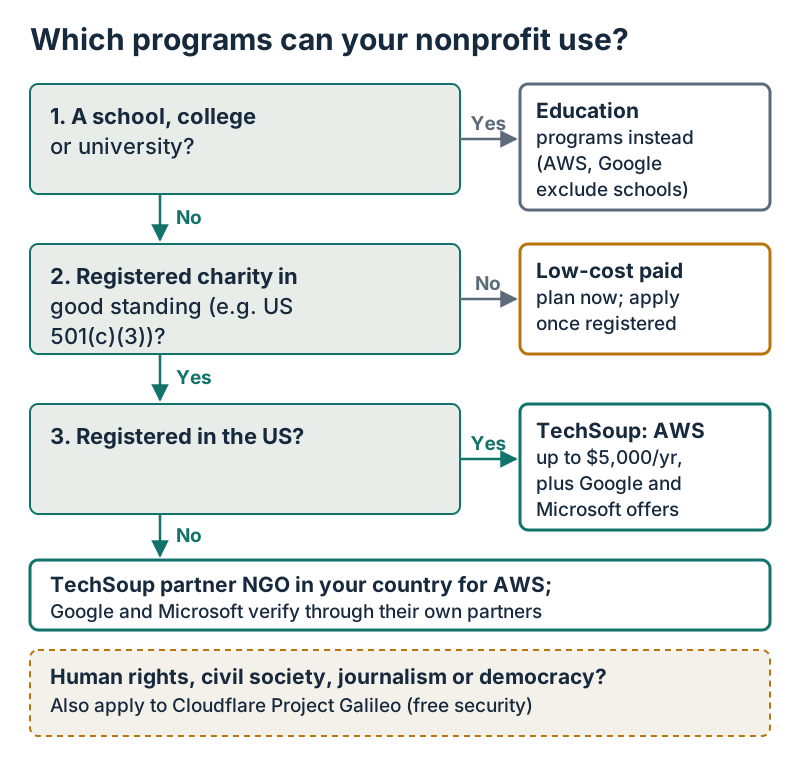
Eligibility runs through verification, not a checkbox. Google verifies charities through a verification partner and excludes government bodies, hospitals and healthcare organizations, and schools and universities. AWS distributes its credit through TechSoup in the US and through TechSoup's partner NGOs elsewhere. Microsoft asks for recognized legal status equal to US 501(c)(3) in your own country, and verifies through its own nonprofit registration; it also excludes schools, government bodies, and political, labor and fraternal organizations. Nothing is switched on until verification is complete, so have your registration documents ready before you apply.
The program registry
Every row below was read from the program's own page on the date shown. Prices are in US dollars as the vendors print them; "free" means free to an organization that passes verification, not to everyone.
| Program | What you get | Who qualifies | How you're verified |
|---|---|---|---|
| Google for Nonprofits | Workspace for Nonprofits at $0 per user (email on your domain, 100 TB shared, Sites); Business Standard $3.50 per user/mo on a 1-year commitment | Charities in good standing; not government, hospitals and healthcare, or schools and universities | Google's verification partner |
| Microsoft Nonprofits | Microsoft 365 Business Basic free for up to 300 users; Business Premium $5.50 per user/mo, paid yearly; $2,000 Azure credit per year | Nonprofits with legal status equal to US 501(c)(3), public libraries and museums; not schools or government bodies | Microsoft nonprofit registration |
| AWS Nonprofit Credit Program | Up to $5,000 AWS credit, one grant per fiscal year (1 Jul to 30 Jun), valid at least one year | 501(c)(1), (3), (8), (9), (11), (12), (14), (15) and public libraries; not schools | TechSoup (US) or a TechSoup partner NGO |
| Cloudflare Project Galileo | Free Business-plan-level protection: DDoS, WAF, CDN, DNS, SSL | Human rights, civil society, journalism and democracy groups with a live site | Cloudflare's partner organizations |
| DreamHost nonprofit discount | Unconfirmed: the /nonprofits/ page returns 404 and isn't in DreamHost's sitemap | Unknown | Ask DreamHost before relying on it |
Two limits in that table catch people out. Google's $0 Workspace and its discounted Business plans stop at 2,000 users, which few small charities will reach. AWS credit can't be spent on everything: AWS lists Route 53 domain registration, Marketplace purchases and upfront fees among the exclusions, so your domain name stays a cash cost. And because each AWS grant is requested per fiscal year, a site that runs on credit needs someone to reapply every year.
The DreamHost row deserves a note. For years its 501(c)(3) offer was a default answer to "free hosting for nonprofits". We found no live page for it on DreamHost's site. It may come back, or DreamHost may honour it on request, but treat any roundup that lists it as out of date until DreamHost confirms it.
What a small nonprofit website needs
Most charity sites have the same job list: explain the mission, take donations, list events, recruit volunteers and publish news. None of that needs a powerful server. It does need a few things done properly. Donations should run through a payment provider's hosted form or checkout, so card data never touches your server and your security burden stays small. Event and volunteer sign-ups need working forms and email that arrives, which is where your email setup matters more than your hosting.
Accessibility deserves a line in your plan too, because nonprofits often serve people who rely on screen readers or larger text. That's mostly about your theme and content, not your host. The host's part is the basics: HTTPS on every page, automatic backups you can restore yourself, and a renewal price you can still afford in year three. A shared plan or a small cloud server can deliver all of that; the difference is who does the maintenance.
There is also a no-server option hiding inside the email offer. Google Workspace for Nonprofits includes Google Sites, a drag-and-drop page builder, so a charity that only needs a handful of pages can publish them at no extra cost. It's a builder rather than a content management system, with no plugin library and limited design control, so it suits a small information site better than a donation-heavy one. If your needs are modest, try it before you pay anyone.
Free program vs cheap paid plan: the 3-year cost
A grant only saves money if someone on your team can use it. Here is the cash cost of hosting one small site for three years, on the free routes and on three low-cost shared plans, with every shared price shown as the first-term price followed by its renewal.
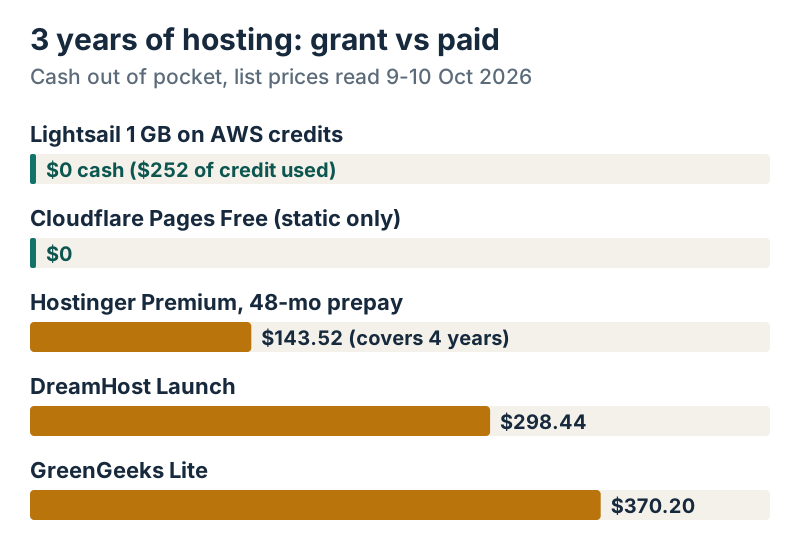
The arithmetic behind each bar: Amazon Lightsail's 1 GB server with a public IPv4 address costs $7 a month, so three years use $252 of credit, well inside one $5,000 grant if TechSoup approves you each year. Cloudflare Pages costs nothing for a static site, which suits a brochure-style charity page built with a static site generator, but it can't run WordPress. Hostinger Premium needs $143.52 upfront for 48 months, which works out at $2.99 monthly, and bills $10.99 a month once that term ends. DreamHost Launch charges $2.89 monthly in year one on its 1-year term and $10.99 after that: $298.44 across three years. GreenGeeks Lite runs $2.95 monthly for 12 months and $13.95 afterwards, so $370.20 in total.
So the grant route wins on cash, and loses on time. A Lightsail server is a bare Linux machine: someone installs WordPress, applies updates, configures backups and fixes things when they break. If your volunteers can't commit to that, the few hundred dollars a shared plan costs over three years buys you a control panel, one-click installs and a support desk. For that route, SiteGround includes unlimited mailboxes and daily backups on its shared plans, with StartUp priced at $2.99 monthly in year one and $17.99 monthly on renewal; Hosting.com includes 5 mailboxes on Starter and free managed migration, with its price shown at checkout. Pair either with free Workspace or Microsoft 365 and your email costs nothing.
Churches and non-US charities: what transfers
Churches and religious groups should check each program separately. In the US, the IRS treats churches that meet the 501(c)(3) requirements as tax-exempt without requiring them to apply, but each verifier sets its own documentation rules, and a church without a determination letter may be asked for more. AWS lists 501(c)(3) organizations as eligible and Microsoft asks for status equal to 501(c)(3); Google decides through its verification partners. None of the three eligibility pages we read says whether churches as such qualify. Apply, and don't plan a budget around a grant until it's approved.
Outside the US, the routes still exist but run through local partners. AWS says international organizations go through a TechSoup partner NGO in their country, and its program describes itself as open to nonprofits around the world. Google and Microsoft verify through their own processes, so confirm that each one operates in your country. Cloudflare's Project Galileo admits organizations through its partner groups. Check each program's own page for your country before you assume a US-registered charity's benefits carry over.
Edge cases before you apply
Fiscally sponsored projects. A project that runs under another charity's umbrella usually can't apply in its own name. The sponsoring organization applies, and the project uses the sponsor's account, so agree who controls the domain and the email admin before you start.
Credit that runs out. AWS credit is valid for at least a year or until it's used. Set a billing alert on the AWS account from day one, so a forgotten test server doesn't eat the grant and leave the charity's card paying for the website.
One volunteer holding the keys. Free programs tie accounts to people. Register the domain, the Google or Microsoft admin and the hosting login to a role address the organization controls, with at least two people able to sign in, or a volunteer leaving can take the website with them.
Mixing paid and free. Nothing stops you from hosting the website on a paid shared plan and running email on Workspace for Nonprofits. That split is often the best value: the host's mailboxes may be free only for a trial, while the nonprofit email offer has no end date as long as you stay eligible. Our web hosting with email guide shows how long host mailboxes stay free.
If you'd rather compare paid hosts on uptime, support and renewal price, our best web hosting for small business ranking covers the same plans from a business owner's point of view.
Sources (read 9-10 Oct 2026): Google Workspace for Nonprofits, Google for Nonprofits eligibility, Microsoft offers for nonprofits, Microsoft nonprofit eligibility, AWS Nonprofit Credit Program, Cloudflare Project Galileo, Amazon Lightsail pricing, IRS Publication 1828; plan pages from DreamHost, Hostinger, GreenGeeks, SiteGround and Hosting.com.
Nonprofit web hosting: common questions
Is there free web hosting for nonprofits?
Does DreamHost still offer free hosting to 501(c)(3) nonprofits?
Can a nonprofit get free email on its own domain?
What is the cheapest hosting for a small nonprofit without a grant?
Can churches get nonprofit hosting discounts?
Ready to choose? See the best web hosting for small business, ranked on business fit, or start with the small-business hosting buyer’s guide.